Evening Edition
The Maker of These Lion's Mane Drops Asks Anyone Over 65 to Check First
MaryRuth's Organic Lion's Mane Liquid Drops come in a one-ounce bottle from Los Angeles. I took that one sentence seriously, wrote down every question it raises, and answered each one the label can.

This is a paid advertisement. Sponsored by MRO MaryRuth, LLC.

The seller's page for this small amber bottle carries one sentence that most readers my age scroll straight past.
It asks anyone over sixty-five to talk with a healthcare professional before they start using it.
I am sixty-eight, so the sentence is about me.
I did not take it as a formality, and I did not take it as a scare either.
I took it as a list of questions I had not yet written down.
So one evening under the porch light I wrote them on an index card, and then I answered every one the label and the seller's own pages could answer.
The ones they could not answer are marked, and they are the ones worth carrying to a counter.
Marvin Teale is the pen name of this desk.
Everything on this page about the bottle comes from the seller's product page, its printed panel, its shipping and refund pages and its public review system, all read in September 2026.
The customers quoted further down are real and their words are public on the seller's own page.
The small pictures beside them are illustrations, not the reviewers.
My sister-in-law left the bottle on our porch table after a Sunday supper.
She had bought two and meant one for my wife, and my wife handed it to me with a look I have learned to read over forty-one years.
The look said: you read labels, so read this one.
I do read labels, mostly in the evening, mostly on the porch, mostly with the light on and a glass of water beside me.
It is a habit from thirty years of fleet maintenance, where every part comes with a sheet and every sheet has one line that matters more than the rest.
A mechanic learns to find that line first.
On this bottle, the line that mattered was not on the glass at all.
It was on the seller's web page, under the directions, in the plain small type a company uses when it means something.
It said, in effect, that children under twelve, adults over sixty-five, and women who are pregnant or breastfeeding should always check with a healthcare professional before using the product.
Most pages that talk about this bottle leave that sentence out.
I understand why, because it does not sell anything.
But I am the reader it was written for, and so are most of the men who will read this page.
If the people who made the bottle thought a man my age should ask first, the least I can do is work out what to ask.
That is what this page is.
It is the card I wrote, the answers I found, and the three or four questions that only a pharmacist or your own clinician can answer, set apart so you can find them.
It is long, because a label is short and the questions behind it are not.

Why I Started With One Sentence on the Seller's Page
Most people start with the front of a bottle.
The front is where a company puts what it wants you to believe.
I start with the directions and the cautions, because that is where a company puts what its lawyers want you to know.
The two are written by different people, and the second group is usually more careful with words.
This bottle is MaryRuth's Organic Lion's Mane Liquid Drops, one fluid ounce, sold by a company registered as MRO MaryRuth, LLC, with an address on South Robertson Boulevard in Los Angeles.
It is a dietary supplement, a liquid, made from one mushroom and two other ingredients.
The directions are short.
Shake gently, and adults take up to one milliliter one to three times a day, or as a healthcare professional recommends.
Then comes the sentence about who should ask first.
It names children, it names pregnancy and nursing, and it names anyone over sixty-five.
There is no explanation beside it.
The seller does not say why sixty-five, and I will not pretend to know the reason they had in mind.
What I can say is what that sentence does for a reader.
It moves the decision from the checkout page to a conversation, and it tells you the company expects that conversation to happen.
A company that writes that sentence is telling you the bottle is not a thing to start on your own after sixty-five, however ordinary it looks.
I respect that more than I respect a front label.
A front label wants a yes; a caution wants you to slow down, and slowing down is the part most of us skip.
So I slowed down.
I took a white index card from the kitchen drawer, sat under the porch light, and wrote the questions in the order they came to me.
Here is the card, as I wrote it that first evening.
- - What exactly is in one milliliter?
- - What does the 1,180 on the panel measure?
- - How long does one bottle last at the dose on the label?
- - How does this compare with the study everybody quotes?
- - Is there anything in it I should not have?
- - Does it argue with anything I already take every day?
- - Who sells it, and what happens if I do not want it?
- - What do people who bought it say, good and bad?
- - What could I change this week that costs nothing at all?
Nine questions.
The label and the seller's pages answer six of them in full, one in part, and two not at all.
The two they cannot answer are the ones the maker's sentence was pointing at.
I will come to them, but first the six that a label can settle on a porch.

What Is in One Milliliter
The panel on the side of the bottle lists one active line and two other ingredients.
That is the whole of it, and there is a relief in a label that short.
The active line is organic lion's mane, Hericium erinaceus, fruiting body extract, at 1,180 milligrams for each milliliter.
The other ingredients are organic vegetable glycerin and purified water.
There is no flavor listed, no sweetener besides the glycerin, and no preservative.
The seller's page says the product is made without alcohol, without gluten and without genetically modified ingredients, and that it is vegan.
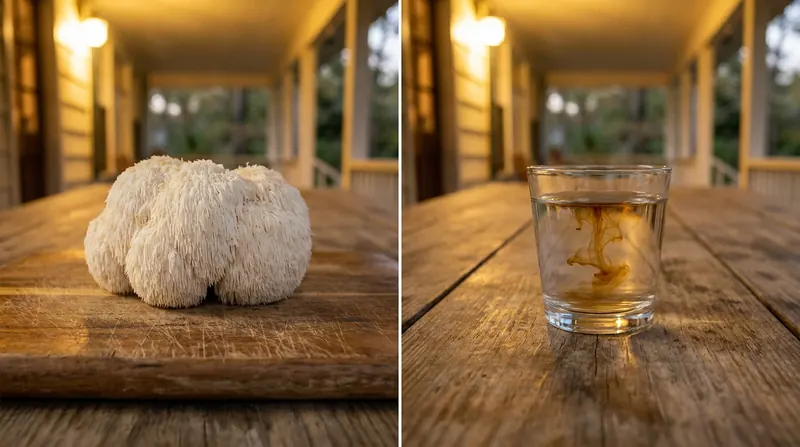
The fruiting body is the part of the mushroom you would see on a tree: a white, shaggy clump with long hanging spines.
It is eaten as food, especially in East Asia, and people who cook it compare the texture to crab.

The label says fruiting body, which matters, because some mushroom products are grown on grain and include the grain in the weight.
This one names only the fruiting body, and that is a point in its favor on any label.
The glycerin is the syrupy, faintly sweet liquid that does the job alcohol does in older herbal extracts.
It draws the compounds out of the plant material, holds them in the liquid and keeps the bottle from spoiling.
The water thins it.
The result is a dark liquid that pours slowly, tastes earthy and sweet at once, and can be taken on its own or stirred into a drink.
Answer to the first question on my card: one milliliter holds a liquid extract of lion's mane fruiting body in glycerin and water, and nothing else.
That was easy.
The second question took the rest of the evening.
What the 1,180 on the Panel Measures
Here is where a man who spent thirty years reading part sheets gets suspicious.
A number is only useful if you know what it is a number of.
The panel says 1,180 milligrams of lion's mane fruiting body extract per milliliter.
The seller's own questions page says the same thing in a different unit: 1.18 grams in each one-milliliter serving.
Now think about what a milliliter weighs.
A milliliter of water weighs one gram, which is a thousand milligrams.
Glycerin is heavier than water.
So a milliliter of a liquid made of glycerin and water weighs somewhat more than a gram.
Put those two facts beside the panel and something becomes clear.
The 1,180 milligrams is roughly what the whole milliliter of liquid weighs.
The label is not hiding that.
It calls the ingredient an extract, it calls the product a liquid extract, and it lists the glycerin and water right underneath.
But it means the figure describes the liquid as a whole, not a weight of dried mushroom inside it.
And the label gives no second number that would let you work out how much mushroom went into each milliliter.
There is no ratio of mushroom to liquid printed, and no figure for the compounds mushroom makers sometimes measure.
Some labels print a ratio like four to one, which tells you four grams of dried mushroom went into each gram of extract.
Some print a figure for beta-glucans, the fibers that make up much of a mushroom's cell wall and that makers use as a measure of how much of a product is really mushroom.
This one prints neither.
That is not unusual for a glycerin extract, and it is not a sign of anything wrong.
It simply means one question on my card has a partial answer.
I know what a milliliter is, but I do not know how much mushroom made it.

Why does any of this matter to a man on a porch?
Because in a moment I am going to put this bottle beside a study, and the study measured its mushroom in dried grams.
Answer to the second question: the 1,180 is the weight of a milliliter of liquid extract, glycerin and water included, and the label does not say how much mushroom that liquid came from.
How Long One Ounce Lasts
This is the question I can answer to the day, and it is the one that surprised me most.
It turns on two numbers the seller prints in two different places.
The panel says servings per container, about thirty.
The bottle holds thirty milliliters and a serving is one milliliter, so thirty is simple division.
But the product description on the seller's page says each bottle comes with sixty servings.
Those two numbers cannot both be right for the same serving.
The only way I can make sixty come out of thirty milliliters is a half-milliliter serving.
The glass tube does have a mark at a half, but the label prints no half-milliliter serving anywhere.
I trust the panel over the description, because the panel is the part of a label the law cares about.
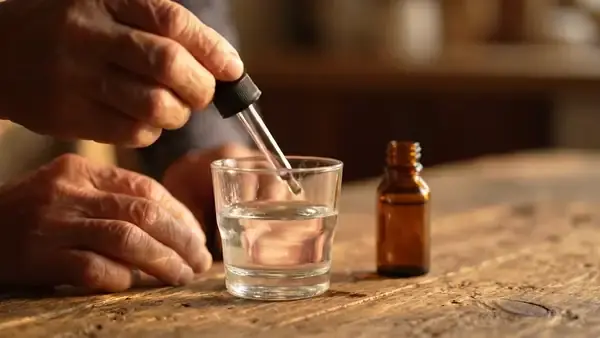
Now take the directions, which allow one milliliter one to three times a day.
At one milliliter a day, a bottle lasts about thirty days.
At two milliliters a day, it lasts about fifteen.
At three milliliters a day, the most the directions allow, it lasts about ten.
So the honest answer to how long a bottle lasts is between ten days and a month.
Which of those you get depends on a choice the label leaves to you.
One of the buyers quoted further down found this out the practical way.
She gave the bottle four stars and wrote that it does not last a whole month at the amount she takes.
She is not complaining about the liquid.
She is complaining about the arithmetic, and the arithmetic is on her side.

The price on the seller's page when I read it on September 21 was $21.95 for the one-ounce bottle.
That works out to about seventy-three cents a milliliter.
At one milliliter a day, that is about seventy-three cents a day.
At three milliliters a day, it is about two dollars and twenty cents a day, and you would be buying three bottles a month.
There is one more piece of arithmetic in this, and it is about shipping.
The seller ships at no charge on orders of $49 or more.
One bottle is under that line and two bottles are under it too.
Three bottles, $65.85, are over it.
So the man who takes one milliliter a day pays for shipping on a single bottle, and the man who takes three a day crosses the shipping line every month.
Neither of those is a catch.
It is just the shape of the purchase, and it is better to see it on a porch than at the checkout.
Answer to the third question: ten to thirty days a bottle, depending on whether you take one, two or three milliliters a day, and the panel's "about 30" is the number to plan by.
The Study Everybody Quotes, Read to the End
Every page about lion's mane leans on the same small study from Japan.
I read it the way I would read a service bulletin, from the first line to the table at the back.
Thirty-one healthy adults over fifty, in Japan, took either a lion's mane fruiting body preparation or a look-alike placebo every day for twelve weeks.
The lion's mane group took 3.2 grams a day, and it scored higher than the placebo group on a standard short test of mental status. [1]
A second test in the same study, of visual memory, did not change.
That is a real finding.
It is also a small study, thirty-one people finishing, in one country, for twelve weeks.
The part that matters most for this bottle is the unit.
The 3.2 grams in that study were grams of dried fruiting body preparation, taken as a powder in a measured amount.
Now go back to the panel.
Three milliliters a day, the most the directions allow, prints as 3,540 milligrams.
On paper, 3,540 is more than 3,200.
It is not the same kind of milligram.
One figure is dried mushroom.
The other is a liquid that is mostly glycerin and water, holding whatever the extraction drew out of an amount of mushroom the label does not state.
You cannot set one beside the other and say this bottle matches the study.
You also cannot say it falls short, because the label does not give you the number to check.
The honest position is that the bottle and the study cannot be compared, and anyone who compares them is guessing.
There is a second study some pages quote, and it is worth one paragraph.
Forty-one adults aged eighteen to forty-five took a single 1.8-gram dose of lion's mane, and an hour later they were faster on one attention task than when they took placebo. [2]
The same study then gave the supplement for twenty-eight days, and that longer arm did not produce a clear result.
The people in it were young enough to be my grandchildren.
So the second study is about a single dose in young adults, and the first is about a dried amount in older adults.
Neither tested this bottle, and neither tested a glycerin extract.
Answer to the fourth question: the study everybody quotes used 3.2 grams of dried mushroom a day, the bottle prints liquid-extract milligrams, and the two cannot honestly be compared.

I want to be fair to the bottle here.
A small study with a positive result is more than many ingredients on the supplement shelf can point to.
And the maker does not quote a result on its own page.
It says the mushroom supports brain function, focus and overall wellness, and it stops there.
That modesty is worth noticing.
The pages that go further than the maker are not the maker.
How Far I Follow the Seller's Own Description
There is a difference between what a company prints on a panel and what it writes in a product description.
The panel is regulated closely; the description has more room, and a careful reader notices how that room gets used.
On this seller's page, the headline claim is short.
It says the liquid supports brain function, focus and overall wellness, which is the ordinary wording of a dietary supplement.
Further down, the description reaches for two older words from the herbal trade to describe what the mushroom has been used for.
I am not going to repeat them, because both promise more than the two studies above can carry.
It also says that with this liquid there is nothing to swallow in the usual way.
That part is simply true, and it is the reason many people choose the format.
I follow the seller as far as the panel and the directions, and I stop where the description starts reaching.
That is not a criticism of this company in particular.
Almost every description on the supplement shelf reaches a little further than its panel, and the panel is where the facts are kept.
What I will credit this seller for is the other thing on the same page, the sentence about checking first.
A company can reach in its description and still be careful in its cautions, and on this page the caution is the more useful of the two.
When a description and a caution disagree in tone, believe the caution.
One more note about the description.
It says the liquid can be taken on its own or mixed into a favorite drink, and I found that to be good, practical advice.
Water works, and so does a small cup of weak tea.
I would not put it in anything hot enough to scald, only because I do not know what heat does to a glycerin extract, and neither the label nor the seller says.
Is There Anything in It I Should Not Have
This question is where the card starts to point at a counter rather than a label.
The label can tell you what is in the bottle, but not whether any of it is wrong for you.
Start with the one clear reason not to take it.
It is a mushroom, and anyone allergic to mushrooms should not take a liquid made from one.
That sounds obvious, but a dark liquid in a small bottle does not look like a mushroom.
If you have ever reacted to mushrooms on a plate, this is the same mushroom family, and the label names it plainly.
Next, the glycerin.
It is widely used in food and is generally recognized as acceptable as a food ingredient, but in large amounts it can loosen the stomach.
At one to three milliliters a day, the amount of glycerin is small.
Still, a man who finds a sweet syrup does not sit well with him will find out in the first few days, and he should stop.
The ingredient guide linked at the foot of this page lists the cautions for lion's mane as they appear in the published sources.
It is short, and it is worth a minute before you buy.
Then there is the thing the label says nothing about: sugar.
Glycerin tastes sweet but is not counted as sugar on a panel, and a milliliter is a small amount.
If you keep an eye on your glucose for any reason, mention the glycerin when you ask, because the person you ask will want to know.
Answer to the fifth question, as far as a label goes: one mushroom, glycerin and water; the clear reason not to take it is an allergy to mushrooms, and the rest belongs on the next question.
The Question a Label Cannot Answer
The sixth question on my card was whether this bottle argues with anything I already take every day.
No label on earth can answer that, because the label does not know what is in your kitchen cabinet.
This is the question the maker's sentence was pointing at.
Most men over sixty-five take something daily, and many take several things, some from a clinician and some from a store shelf.
The only person who can look at all of it at once is a pharmacist or your own clinician.
And the only way they can look at all of it is if you bring all of it.
So here is the practical version of the maker's sentence, the way I did it.
I put everything I take into one brown paper bag.
The things a clinician gave me, the vitamin from the store, the thing my wife talks me into every winter, and this small amber bottle.
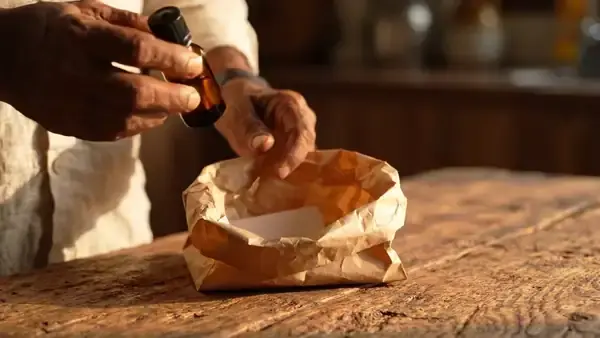
Then I took the bag to the counter on a quiet weekday morning, when there was no line.
I asked three questions, and I will give them to you exactly as I asked them.
- Is there anything in this bag that is a poor fit for a man my age?
- Does anything here argue with a mushroom extract in glycerin?
- The maker asks people over sixty-five to check first; is there any reason for me in particular not to start it?
The answers are mine and not yours, so I will not print them.
Your bag is different from my bag, and that is the whole point of carrying it.
What I will say is that the conversation took about four minutes.
Nobody sold me anything, nobody made me feel foolish, and I walked out with a clearer head about everything in the bag, not only the new bottle.
Four minutes at a counter is the cheapest thing on this entire page, and it is the one the maker asked for.
If you do not have a regular pharmacist, any pharmacist will do.
If you would rather ask your own clinician, bring the bag to your next visit and ask the same three questions.
And if the answer is not to start it, then do not start it.
That is the sentence working exactly as the people who wrote it intended.
Answer to the sixth question: the label cannot answer it, a pharmacist or your clinician can, and the bag is how you let them.
The Seventh Question, and Who Wrote the Sentence
The seventh question on my card was really two: who sells this, and what happens if I do not want it.
I like to know who is on the other end of a purchase before I make it.
The bottle is made and sold by MRO MaryRuth, LLC, trading as MaryRuth's.
The company lists a street address, 1171 South Robertson Boulevard, number 148, in Los Angeles.
It lists a telephone number, 310-955-1353, and an email address, wecare@maryruthorganics.com.
A company that publishes all three is a company you can reach, and that alone puts it ahead of plenty of sellers on the supplement shelf.
Six questions in, I had read the whole label before I had properly looked at the bottle.
So this is the point where I set it down in the middle of the porch table and looked at it the way a buyer would.
The seller offers a thirty-day satisfaction window on purchases from its own site, with a refund.
Thirty days lines up neatly with one bottle at one milliliter a day, which is a fair amount of time to decide.
The seller ships inside the United States, and at no charge on orders of $49 or more.
The brand is also sold in large stores and on the big online marketplaces, where the price and the terms are that store's, not the maker's.
If you buy it anywhere but the seller's own site, the thirty-day window on the seller's page may not apply to you, so read the store's terms instead.
There is one more thing about the company, and it is about that sentence.
The same page that lists the directions says the directions are for adults fourteen and over.
The brand makes a lot of products for families, and that is why the youngest age is on the label.
It is also why the sentence about checking first names children and pregnancy before it names men my age.
The sentence was not written for me alone.
But it includes me, and a company that bothers to write it for a family product is being careful in a way I appreciate.
Answer to the seventh question: a Los Angeles company with an address, a phone and an email, thirty days to return it from its own site, and shipping at no charge from $49.

What Four Buyers Wrote, Good and Less Good
The eighth question was what people who bought it say.
The seller's page runs a public review system, and it marks the reviews that come from confirmed purchases.
I read the most recent twenty-five that the system returned.
Then I set some aside, and I want to tell you which ones and why, because a page that chooses reviews without telling you the rule is hiding the rule.
I set aside four that were about giving the liquid to children, because this page is written for men over fifty-five.
I set aside two about shipping problems, a wrong item and a broken bottle, because they are about a courier and not a liquid.
I set aside one that compared this bottle with other formats in words this page does not use, and one that described a change in thinking I have no way to check.
I set aside two without the purchase mark, and the ones that said only "five stars" and nothing else.
That left a handful, and I kept four of them, including one at four stars that makes a fair complaint.
Here they are, word for word.

Taken as recommended, this product does well for me.

I love MaryRuth Lion Mane.

I got this since I can no longer get the powder I was using before and these drops are just as good for helping me focus at work. I love them!

Bottles are too small for the amount required to take daily and don't last a whole month. I feel like the product could be good if didn't run out so soon and have to reorder so often.
Read them one at a time, the way I did on the porch.
Sallie says "taken as recommended," and I like that she says it, because it means she followed the label.
Laurie says only that she loves it, in six words, and uses the brand's name the way people do when they have bought it more than once.
Short reviews like hers tell you about loyalty to a brand rather than about a liquid, and that is still worth knowing.
Erinn came from a powder she could no longer buy, and she likes this for focus at work.
She is younger than me, and I take her review as a word about the format as much as the contents.
And Tyra, at four stars, says the bottles are too small for the amount she takes and do not last a month.
Tyra's review is the one whose details you can check against the panel, and the panel proves her right.
If she takes more than one milliliter a day, a thirty-milliliter bottle runs out in two or three weeks.
That is not a flaw in the liquid, it is the arithmetic from the section above, found by someone who paid for it.
Four reviews are four opinions about a purchase, and a purchase is a different thing from a study.
None of these women is my age, and none of them is a man.
That does not make their words less real, but it does mean none of them was the reader the maker's sentence was written for.
Answer to the eighth question: buyers like the ingredients and the format, and the one fair complaint is that a bottle empties sooner than people expect.
The Ninth Question: What Costs Nothing This Week
This is my favorite line on the card, and I put it last on purpose.
Before any bottle, there are things a man can change this week that cost nothing and that nobody sells.
I am not going to give you a list of forty.
I am going to give you the four I actually changed after I wrote the card, with the reason for each.
The first is water.
In a study in Berlin that followed 1,111 adults aged sixty to eighty-nine, the third who were measurably short of water did worse over time on a test of how quickly they could process information. [3]
A review of eighteen studies in adults over sixty found the same kind of link, and said plainly that the evidence on thinking was sparse. [4]
That is an association, not proof, but a glass of water costs nothing and the thirst signal weakens as we age.

I keep a glass on the porch table now, and I finish it before I go in.
That is the whole change, and it is the cheapest one on this page.
The second is the plate.
In a three-year trial of 604 older adults, the group that ate the MIND way, heavy on leafy greens, berries, beans, nuts, whole grains, olive oil and fish, improved on thinking tests. [5]
But a comparison group that simply ate a little less also improved, by about the same amount.
The honest reading is that paying attention to what you eat helped both groups, and no single food made the difference.
A large Brazilian study of 10,775 adults pointed the same way from the other side.
Over about eight years, people who ate the most ultra-processed food slipped somewhat faster on tests of thinking than those who ate the least. [6]

So the change I made was small.
Fewer things from a packet, more things from a produce bin, and no promise attached to any one of them.
The third is a blood test I had not had in years.
Low vitamin B12 is common in older adults, with estimates ranging from three to forty-three percent depending on how it is defined, and it is easy to measure. [7]
I asked my own clinician to check it at my next visit.
A number on a lab sheet is worth more than any guess, and it is the kind of question the maker's sentence invites.
The fourth is the one I cannot cite, because it is common sense.
When I want to remember something, I write it on a card, the way I wrote this one.
A card, a glass of water, a plate and a lab number: none of it is sold by anybody, and all of it comes before a bottle.
Answer to the ninth question: water, the pattern of your plate, a B12 number and a pencil, all of them this week and all of them at no cost.
What the Glycerin Means in a Man's Day
There is one thing about this bottle I have not said enough, and for a lot of men my age it is the deciding thing.
It is made without alcohol.
Older herbal liquids were made in alcohol, and some still are.
A serving of those is a small amount, but a man who has chosen not to drink, for any reason, does not want even a small amount.
This one uses glycerin instead, and the seller says so on the front of its page.
For a man who has stopped drinking, or who takes something daily that does not mix with alcohol, that is a real difference.
The glycerin also changes the taste.
It is sweet, a little thick, and earthy from the mushroom, which is not everyone's favorite but is easier than the burn of an alcohol base.
The seller says you can take it on its own or mix it into a drink.
I tried it in a small glass of water, in the evening, and the water carries the sweetness without hiding the earthiness.

There is one practical point about the glass tube in the cap.
It is marked at a quarter, a half, three quarters and a full milliliter, and those marks are the only honest way to take the dose on the label.
Squeeze the bulb, let it fill, and read the line at eye level, the same way you would read the oil on a dipstick.
If you guess, you will take more than you think, and the bottle will run out sooner than the panel says.
The marks on the tube are the dose, and a man who uses them gets his thirty days.
Store it closed, away from heat, and shake it gently before each use, as the directions ask.
Those are small habits, but a liquid that is mostly glycerin and water is the kind of thing that rewards them.
Why a Liquid Suits a Man Who Would Rather Not Swallow Anything
A lot of men my age have a cabinet that rattles.
Every new thing on the shelf is one more thing to swallow with a glass of water, and some of us have simply had enough of that.
A liquid changes the gesture.
You squeeze a bulb, read a line, and let a small amount of dark liquid run into a glass or onto a spoon.
There is nothing to get stuck, nothing to cut in half and nothing to count out of a bottle into your palm.
For a man who has trouble with the size of what he swallows, that alone can decide it.
The marks on the tube also let you do something a fixed dose cannot.
You can start at a quarter or a half milliliter for the first few days, see how the sweetness and the earthiness sit with you, and move to the full milliliter when you are ready.
The label does not tell you to do that, and I am not telling you to either.
But the marks are there, and a man who has been told at the counter to go carefully has a way to go carefully.
The format is the reason many people choose this bottle, and it is a fair reason.
The bottle is amber glass, which keeps light off the liquid, and it is small.
It stands about as tall as a deck of cards and fits in a shirt pocket, though I would not carry a glass bottle in a pocket myself.
It also travels.
At one fluid ounce it is well under the 3.4-ounce limit the airport screening rules set for liquids in a carry-on bag, so it can go in the clear quart bag with your toothpaste.
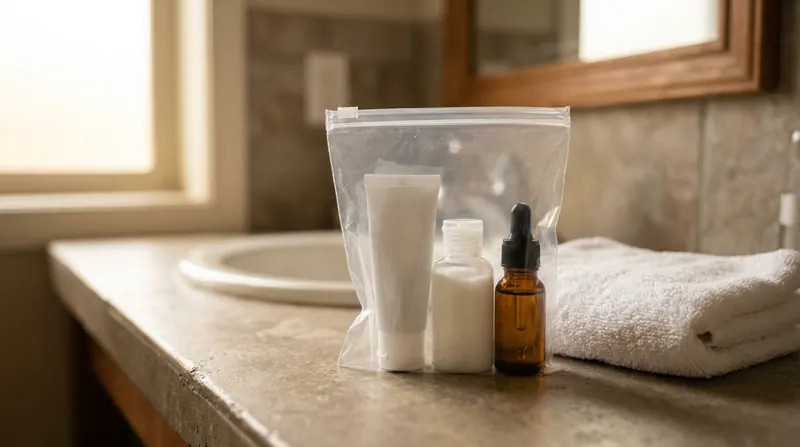
That matters more than it sounds for a habit you mean to keep.
A routine that stops every time you visit your daughter for a week is not a routine.
One practical note from a man who has dropped things on porches: glass breaks.
Two of the reviews I set aside were about a bottle that arrived broken or was the wrong item, and both were shipping problems rather than problems with the liquid.
If a bottle arrives cracked, write to the seller the same day and keep the box, because thirty days is not long.
The last thing about the format is honesty about what it is not.
A liquid is not stronger because it is a liquid, and it does not work faster because it is a liquid.
It is a different way of taking an amount the label sets.
Anyone who tells you the format itself does something is selling the format, not the mushroom.
What the Word Organic on the Front Does and Does Not Mean
The front of the seller's page carries the round green-and-white organic seal of the United States Department of Agriculture.
It is one of the few words on any supplement shelf that has a published rulebook behind it.
Organic, on a label like this, is a statement about farming and handling.
It means the mushroom and the glycerin were grown and processed under a standard, and that a certifier checked the paperwork and the practice.

It says nothing about strength.
An organic liquid can hold a great deal of mushroom or very little, and the seal will look the same either way.
It says nothing about whether the liquid does anything for a man's focus or his week.
That is a different question, and no seal answers it.
The seal is a promise about how the mushroom was grown, not about what it will do.
I still count it as a point in the bottle's favor.
A man who cares where his food comes from can apply the same care to a small bottle, and the seal is one way to do it.
The other words on the front, vegan, gluten and genetically modified, are statements of what is not in the bottle.
For a liquid of three ingredients, one mushroom, glycerin and water, they are easy statements to make, and I have no reason to doubt them.
What I notice more is what the front leaves off.
It does not print a ratio, a figure for the compounds in the mushroom, or the name of a study.
A company that wanted to impress a label reader could have printed any of those.
This one prints its seal, its short list and its sentence about checking first, and leaves the rest to the reader.
I would rather read a short label that stops where its knowledge stops than a long one that keeps going past it.
Who This Bottle Suits, and Who It Does Not
By the end of the evening I could say, plainly, who I think this bottle is for.
I will say it the way I said it to my wife when I came in from the porch.
It suits a man who does not want to swallow anything, who has chosen not to have alcohol, and who likes a small evening habit with a glass of water.
It suits a man who likes a short label he can read in one breath, from a company he can call on the telephone.
It suits a man who has taken the maker's sentence seriously, carried his bag to the counter, and been told there is no reason not to start.
That man knows what he is buying: one mushroom, in a sweet liquid, at a dose the label sets and the tube measures.
It does not suit a man allergic to mushrooms.
It does not suit a man who has been told at the counter not to start it, and that answer outranks everything on this page.
It does not suit a man who wants a number he can set beside a study, because this label does not give one.
And it does not suit a man who expects a bottle to do the work of water, a plate and a lab number.
If you are buying it to match the study everybody quotes, you are buying a hope rather than a match, and it is fair to know that before you pay.
I will add one more thing, because it is true.
A small bottle is sometimes the thing that gets a man to sit still on his porch for ten minutes every evening, and that has a value of its own.
If the habit is what you are buying, this is a pleasant one.
Just keep the habit and the hope in separate columns, the way I keep parts and labor.
A Thirty-Day Card of Your Own
If you go to the counter and come back with a yes, there is one more card worth writing.
It is the one I am keeping now, and it costs a second index card and thirty seconds an evening.
At the top, write the date you opened the bottle and the date the seller's thirty days run out.
That second date is the one people forget, and it is the only one that matters if you decide the bottle is not for you.
Then, each evening, write one line.
Not a paragraph, not a score out of ten, just one line about the day.
- How much you took, by the marks on the tube.
- What time you took it, and whether with water, tea or on its own.
- Anything your stomach had to say about it.
- One ordinary thing about the day you would want to remember.
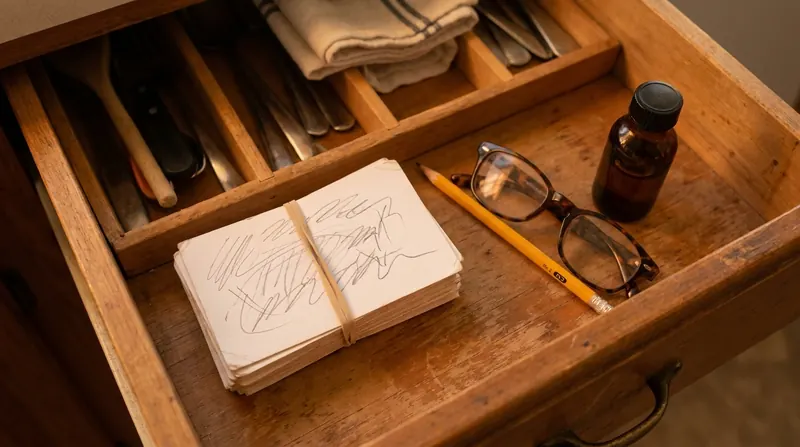
The last line is not a test.
It is a way of making the card about your days rather than about the bottle, which is where a man's attention belongs.
Around day twenty-five, read the whole card back in one sitting.
If the habit has been pleasant and nothing on the card worries you, you know what to do next.
If your stomach has complained, or the taste has become a chore, or you have simply stopped wanting the habit, you still have a few days to write to the seller.
That is why the second date is at the top.
A card with thirty short lines is a better witness than a memory of thirty evenings.
I will be honest about one thing the card cannot do.
It cannot tell you whether the liquid did anything for your head, because a month of your own evenings has no placebo group.
The study everybody quotes needed thirty-one people, a look-alike placebo and twelve weeks to find one higher score.
One man with one card for thirty days is not going to settle what that study could only suggest.
What the card can do is keep you honest about the habit, the dose and the money.
Those three things are yours to judge, and a card helps you judge them.
Keep the card in the kitchen drawer with the pencil, not in your head, because a head is the worst place to keep a record.
My wife says I have turned a small bottle into a filing system.
She is right, and I have decided that is what a man who spent thirty years with part sheets ought to do with it.
The next part of this page is the bottle itself, with the seller's terms beside it.
After that come the short questions people ask, and then the whole card read back in one sitting.
Every line on the panel of this bottle, with the amount the label gives and the published sources behind the lion's mane line, is written out in the ingredient guide linked at the foot of this page.
The guide also carries the cautions, the full references and the disclosures this page is required to make.
One ounce of lion's mane, a milliliter at a time
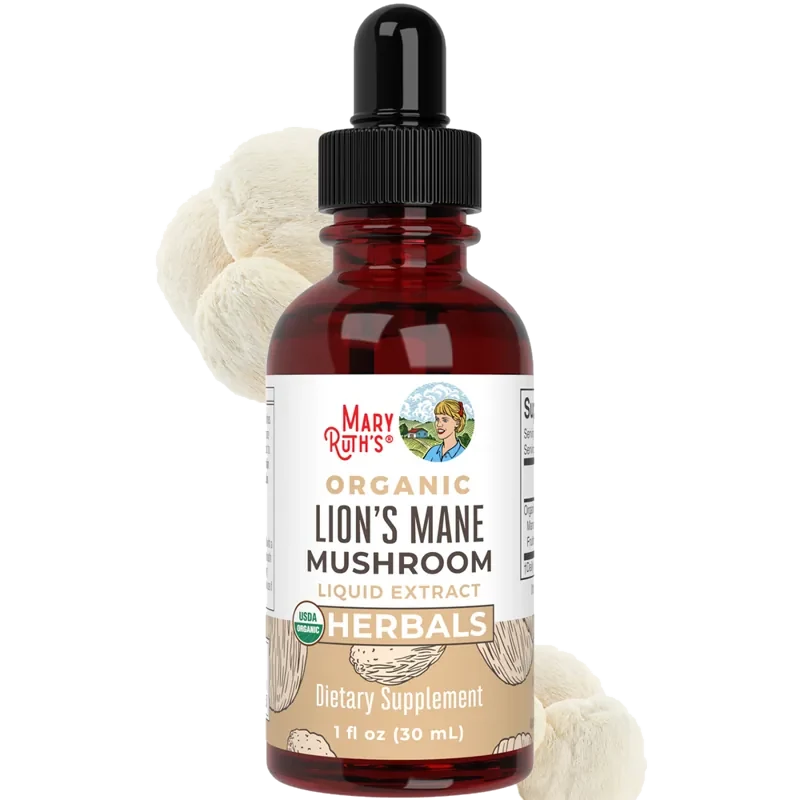
A measured milliliter of organic lion's mane extract in glycerin and water, from a Los Angeles family company, with the dose printed on the glass.
SEE THE ONE-OUNCE BOTTLESold by MRO MaryRuth, LLC, Los Angeles · 1 fl oz (30 mL), 1 mL a serving, up to three a day · refund window of 30 days on the seller's site · shipping at no charge from $49 in the US
Short answers to what porch neighbors ask
Is this medicine?
No. It is a dietary supplement made from one mushroom in glycerin and water, and it is not meant for any medical condition.
Why does the maker ask people over 65 to check first?
The seller does not give a reason. It names adults over sixty-five with children and pregnancy, and asks all of them to talk with a healthcare professional before using it.
How long does one bottle last?
About thirty days at one milliliter a day, fifteen at two, and ten at three. Plan by the panel's "about 30," not the "60 servings" in the description.
How much mushroom is in a milliliter?
The label does not say. It prints 1,180 milligrams of liquid extract per milliliter, which is roughly the weight of the liquid itself, and gives no ratio.
Does it contain alcohol?
No. The base is organic vegetable glycerin and purified water.
Who should not take it?
Anyone allergic to mushrooms, and anyone told at the pharmacy counter or by their own clinician not to start it.
What if I do not like it?
The seller offers thirty days on purchases from its own site. Write to wecare@maryruthorganics.com or call 310-955-1353.
Are the reviews real?
Yes, and they carry the purchase mark of the seller's review system. I read twenty-five and quote four, including one at four stars.
The Card, Read Back in One Sitting

- MaryRuth's Organic Lion's Mane Liquid Drops: one fluid ounce, thirty milliliters, made and sold by MRO MaryRuth, LLC, of Los Angeles.
- One milliliter holds 1,180 milligrams of lion's mane fruiting body liquid extract, in organic vegetable glycerin and purified water, made without alcohol.
- The 1,180 milligrams is roughly the weight of the whole milliliter of liquid; the label prints no ratio and no beta-glucan figure.
- The directions allow up to one milliliter one to three times a day, measured with the marked glass tube in the cap.
- The panel says about thirty servings and the product description says sixty; at the label's dose a bottle lasts ten to thirty days.
- The study everybody quotes gave 3.2 grams a day of dried fruiting body to thirty-one adults over fifty for twelve weeks and found a higher score on one short test. [1]
- A second study gave one 1.8-gram dose to adults aged eighteen to forty-five and found a faster result on one task an hour later. [2]
- Neither study tested this bottle, and liquid-extract milligrams cannot be set beside dried-mushroom grams.
- The seller asks anyone over sixty-five to talk with a healthcare professional first; the practical way is one bag, everything you take, and three questions at a counter.
- The one clear reason not to take it is an allergy to mushrooms.
- $21.95 a bottle on September 21, about seventy-three cents a milliliter; a refund window of thirty days on the seller's site; shipping at no charge from $49.
- Four reviews quoted word for word, one at four stars saying a bottle does not last a month.
- Before any bottle: a glass of water, [3] [4] the pattern of your plate, [5] [6] a B12 number [7] and a card in your pocket.
Back Under the Porch Light
I finished the card on a Thursday.
On Friday morning I carried the bag to the counter, and on Friday evening I sat back down on the porch with the answers.
The answers were mine, and they said there was no reason for me not to try it.
So I did, one milliliter in a small glass of water, at the same hour, with the light on.
I am not going to tell you what it did for me, because I do not trust any man who reports on his own head after ten days.
I will tell you that the habit is pleasant, that the taste is earthy and sweet, and that the bottle will last me a month because I take one milliliter and use the marks.
My sister-in-law takes two a day and is buying her third bottle.
She did the arithmetic after I showed her the card, and she laughed and said she had wondered why it kept emptying so fast.
My wife read the card too.
She said it was the most useful thing I had written since the grocery list, and I have decided to take that as praise.
Here is the whole of it, the way I would say it across a porch rail.
This is a short, honest label from a company you can reach, holding one mushroom in a sweet liquid with no alcohol, at a dose you measure yourself.
It does not print how much mushroom went into it, so it cannot be matched to the study everybody quotes.
And its makers wrote one sentence for men my age that is worth more than anything on its front.
Take the sentence seriously, carry your bag to the counter, and then decide with the answer in your hand.
If the answer is yes, buy one bottle, take one milliliter a day with the marks, and give it the thirty days the seller gives you.
If the answer is no, you have lost nothing but four minutes, and gained a clearer picture of everything in your cabinet.
Either way, finish your glass of water before you go in.
That part I can recommend without asking anyone.
Thirty milliliters, thirty days to decide
A measured milliliter of organic lion's mane extract in glycerin and water, from a Los Angeles family company, with the dose printed on the glass.
SEE THE ONE-OUNCE BOTTLEMRO MaryRuth, LLC · 1171 S Robertson Blvd #148, Los Angeles, CA 90035 · 310-955-1353 · refund window of 30 days on the seller's site · ask first if you are over 65
P.S. If you keep one thing from this page, keep the three questions for the counter.
Is there anything in this bag that is a poor fit for a man my age, does anything here argue with a mushroom extract in glycerin, and is there any reason for me not to start it?
P.P.S. If something about your own memory has been bothering you for months, before the coffee as well as after it, take that to your own clinician before you buy anything at all.
A small amber bottle was never meant to answer that question, and its makers, to their credit, never said it was.